Updated: May 2026

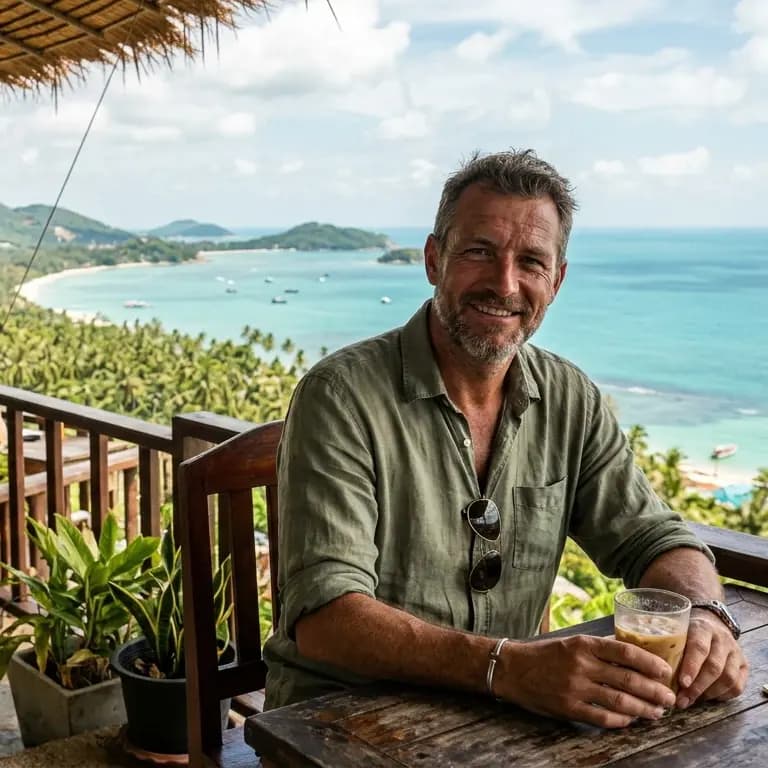
French · 7 years on Samui
French motorcycle tour guide living on Koh Samui for 7 years. Marc leads group rides across southern Thailand and knows every road on the island.
Six years living on Koh Samui and I still meet long-stay visitors who have never found the backroad between Mae Nam and Bo Phut. It does not appear on the tourist fold-out maps given out at hotels. It is not on any guesthouse recommendation board I have seen. Ride it on a scooter or a motorbike and you discover a different island entirely - one that exists behind the resort perimeter, moving at the pace of the people who actually live here.
The turn is easy to miss the first time. Heading east along the ring road through Mae Nam, I take the narrow left just past the fresh market - the one with the hand-painted fish sign, not the 7-Eleven junction. Immediately the asphalt narrows to one generous lane and the coconut palms close in on both sides. On the Yamaha Filano the low seat and upright riding position make the sudden narrowing feel comfortable rather than claustrophobic. I have ridden this road every week for three years and still feel a small satisfaction each time I make that turn.
For about four kilometres the road runs between working coconut farms where the ground is swept daily and chickens wander the verges. There are no speed humps on this stretch, no road markings, and almost no traffic beyond the occasional farm truck moving slowly enough to greet. On a Honda Click 125 or a Filano the pace is perfect - fast enough to keep momentum through the slight inclines, slow enough to see the fruit bats hanging in the tallest palms at dawn.
Where the track meets the village road at Ban Bo Phut, the character shifts. The coconut farms give way to shophouses selling agricultural supplies and spare parts for the small engines that run this part of the island. I always stop at the orange drink cart run by the same woman who has been there every morning since I first rode through. Her nam manao - fresh lime juice with salt - costs 20 baht and tastes like what Samui actually is, as opposed to what the resort brochures say it is.
Where the road meets the coast again at Bang Rak, the smell of dried squid from the small processing sheds arrives before the sea view. I always stop at the low concrete pier here and park facing the water. On clear mornings Ko Pha-ngan sits close on the horizon and the ferry crossing from the pier looks like a slow toy on a flat blue table. It takes three minutes. It is worth stopping for. A Honda CB300R parked on that pier with the Gulf behind it is one of the better photographs I have taken on this island.
The last kilometre runs parallel to the beach road into Fisherman's Village. On Friday evenings the walking street is set up with food stalls and the riding becomes social rather than purposeful - I slow to a walking pace and the scooter becomes a prop rather than a vehicle. The road ends at the roundabout by the Samui Pier, which is also where the ring road resumes. I have never once taken the ring road back when this alternative exists.
The backroad is not technically demanding - any scooter handles it easily. But it is narrow enough that a wider bike feels less comfortable. The Honda Scoopy and Yamaha Filano are ideal: low, light, manoeuvrable. The Honda Click 125 fits perfectly too. If you want the motorbike experience, the CB300R is light enough at 143 kg to navigate the farm tracks without intimidating the local cats. Avoid the XMAX 300 here - its width and length work against you on the tightest farm junctions.
I have ridden the full Koh Samui ring road dozens of times. This is the exact route I recommend to every renter - start times, fuel stops, and the bends worth slowing down for.
The climb to the Big Buddha viewpoint is Samui's most rewarding road - if you take the right approach. Here is how I tackled it safely on a 125cc scooter.
I cycled the full Koh Samui ring road in three days. This guide covers every hill, fuel station, rest stop, and shortcut I found along the way.