
Spanish · 5 years on Samui
Spanish cycling enthusiast and eco-travel advocate on Koh Samui for 5 years. Carlos covers all bicycle and e-scooter content with a focus on sustainable exploration.
Updated: May 2026
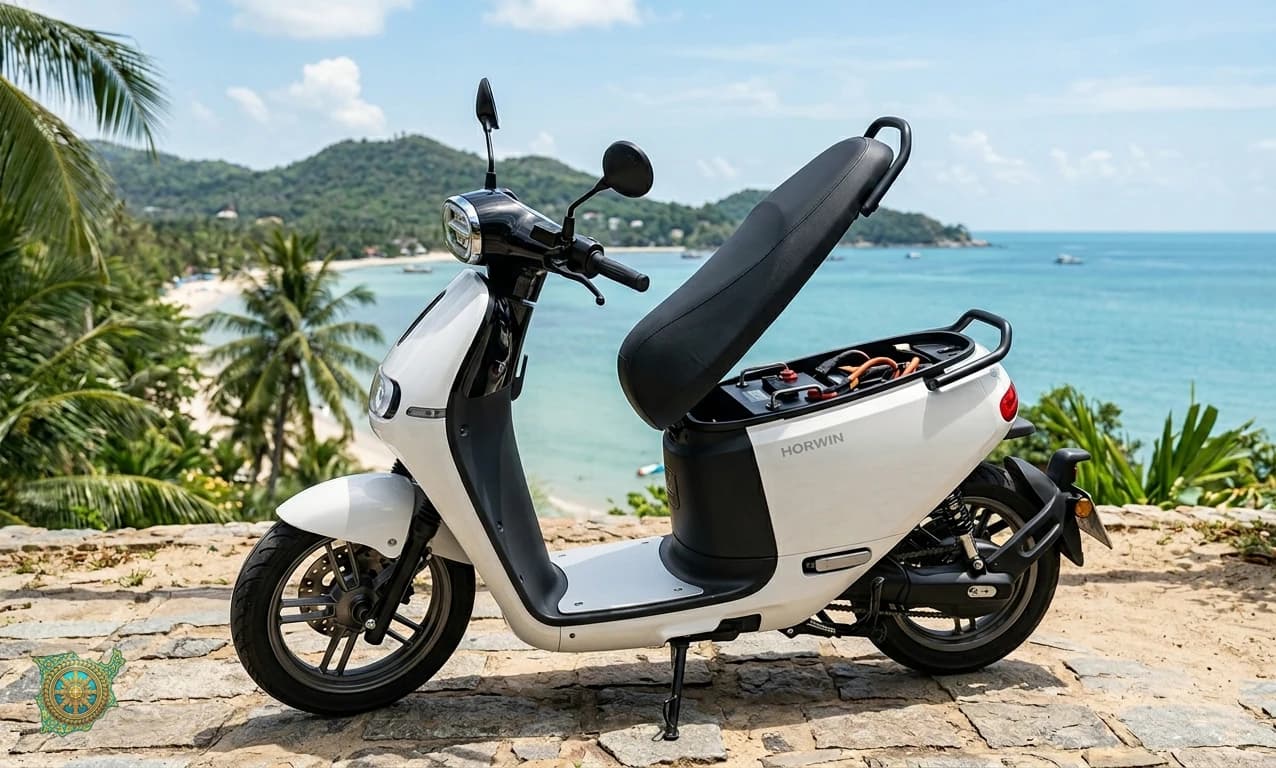
At the Mae Nam guesthouse last February I plugged the EK3 into the standard 220V socket and watched both battery indicator segments on the display begin climbing simultaneously. The EK3's dual batteries charge in parallel from a single connection - one socket, one plug, two batteries charging together. I did not need to manage two charging cables or connect separately to each pack. After 5 hours the display showed both segments at 100 per cent. The dual battery system operates as a unified charging unit from the rider's perspective.
Riding the EK3 from Chaweng to Nathon last October - 22 kilometres of mixed coastal and ring road tarmac - I monitored the dual battery display throughout the ride. Both segments depleted at the same rate, declining in parallel rather than one depleting before the other began. The EK3's management system draws from both batteries simultaneously and maintains even discharge across the two packs. The rider sees a single effective range figure, not two separate battery management decisions. The dual system is transparent in use.
Testing the EK3's range on the flat coastal road last November at 42 km/h average, I measured 0.9 per cent of total combined battery capacity per kilometre - equivalent to approximately 110 kilometres of theoretical range. Real-world range at mixed Samui speeds of 45 to 55 km/h averaged 80 to 90 kilometres per full twin-charge across multiple test rides. On the north coast circuit of 38 kilometres last February, I completed the route and returned with 55 per cent combined remaining - enough for a second full circuit.
From fully depleted to full charge last October at the Chaweng guesthouse socket: 6 hours 30 minutes for both batteries simultaneously. From 30 per cent combined to full: approximately 4 hours. A midday café stop of 90 minutes recovers approximately 22 percentage points of combined charge - useful for extending the day, but not a quick top-up in the way the Super Soco CPx's battery swap is. For the EK3's extended range, the practical approach is to charge overnight and begin each day fully charged, rather than planning midday charge stops.
At the rental handover last January I asked specifically what happens if one battery fails mid-ride on the EK3. The staff confirmed: the EK3 continues operating on the remaining battery with reduced range - approximately half the dual-battery range. I tested this by manually disabling one battery connection during a static test. The display showed the single-battery state and adjusted the range estimate accordingly. On Samui, where the maximum distance from a charge point is rarely above 20 kilometres, a single-battery emergency is a range-management situation, not a stranding.
Five years of riding the Horwin EK3 on Koh Samui has produced a consistent understanding of the dual battery: it is most valuable not as a safety backup but as a planning simplifier. A single battery requires careful monitoring; the EK3's dual system pushes the planning threshold far enough that most Samui circuits become range-agnostic. I still check the battery display before long circuits, but I have never been stranded on the EK3 - not once across five years of varied Samui routes. The dual system earns that reliability record.
Interested in renting Horwin EK3?
Check live availability and pricing for the Horwin EK3 on Koh Samui.
Show availableFirst-hand Horwin EK3 guides from our local team - where to ride it, when, and how to get the most from it on Koh Samui.

Browse the fleet, check availability, and contact us directly from your phone. Free on iOS and Android.
First-hand road and trail guides written by our local team - where to go, when to ride, and what to watch out for.