Updated: May 2026

Russian · 6 years on Samui
Russian travel blogger and safety advocate based on Koh Samui for 6 years. Elena specialises in practical first-timer advice for renting vehicles on the island.
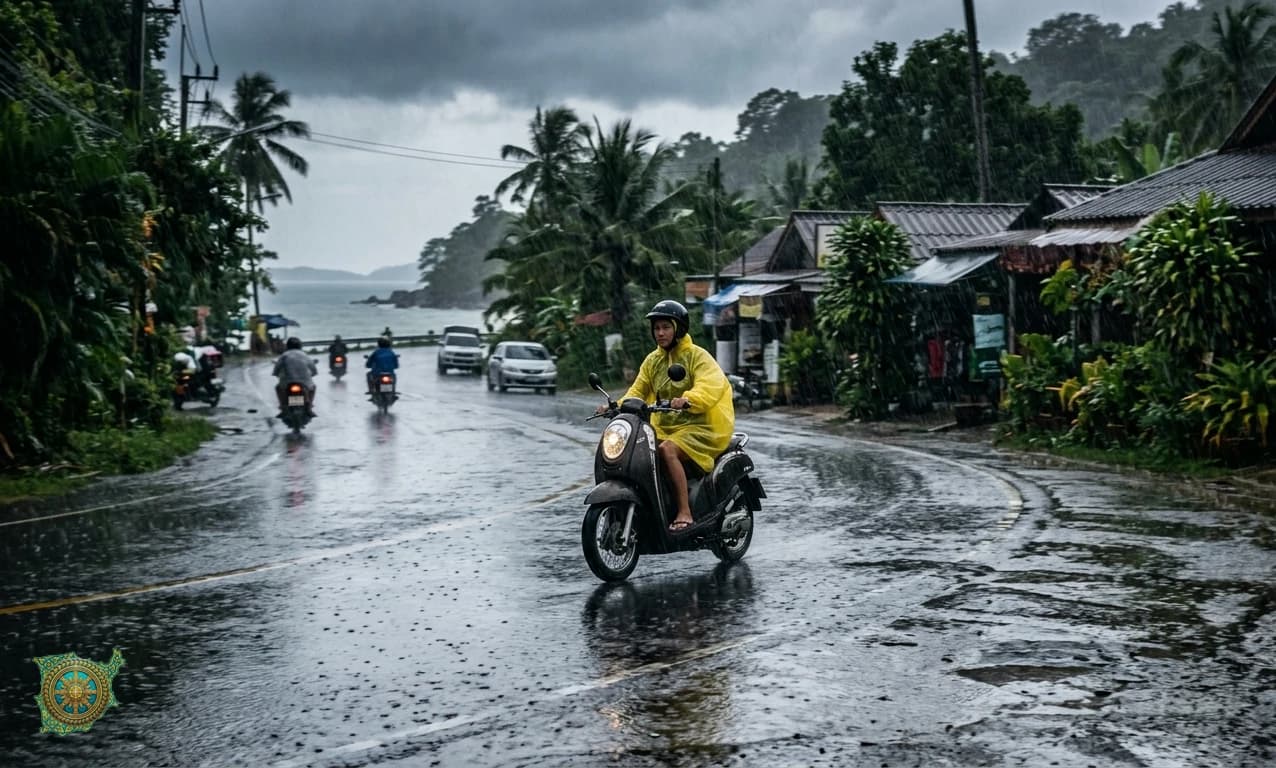
Rain on Koh Samui during monsoon season is not a light European drizzle you ride through while barely adjusting your speed. It arrives as a curtain - warm, heavy, and fast enough to reduce visibility to fifty metres in under a minute. The road surface temperature is higher than the rain, which means the first water on the tarmac creates a steam layer that sits between the tyre and the grip surface. I had to experience this twice before I understood it as a physical reality rather than an abstract warning.
It was a November afternoon, the kind where the sky gives no warning and the road is wet before you register that it is raining. I was on a Honda Scoopy coming south out of Lamai when the front wheel found a painted road marking - the white crosswalk stripe - and stepped out for a fraction of a second before recovering. I did not fall. But the sensation of the front going light stayed with me for days. Painted lines, manhole covers, and road markings become ice on Samui tarmac in the first two minutes of rain.
Most rental scooters are returned with tyres at the wrong pressure and rented out again before anyone checks. I started checking the tyre pressure of every bike I rent the moment I take custody of it - I carry a small gauge in my bag. Correct pressure for a 125cc scooter in Samui heat is typically 26-28 psi front, 29-32 psi rear. An overinflated tyre in wet conditions is dramatically less forgiving than one set correctly. If the rental shop cannot tell you the spec, look for the sticker on the swing arm.
Thai roads during monsoon have a film of oil that rises from the tarmac pores when first wetted before washing away in sustained rain. That first five minutes of a shower is the most dangerous window. I triple my following distance in this period and cover the rear brake lightly - not applying it, just ready. The instinct to use the front brake hard is the one to override. Rear brake pressure distributed smoothly across a longer distance is what keeps you upright on a greasy surface. The Yamaha NMAX 155's dual-channel ABS changes this calculation significantly in your favour.
After the Lamai incident I bought a lightweight rain poncho that fits over a helmet without lifting in the wind - the kind sold at every 7-Eleven for 79 baht. It is not elegant but it keeps the visor dry and your core temperature stable enough that your concentration stays where it belongs. The alternative - riding wet - is not a comfort issue alone. Cold muscles respond slower. A slightly impaired reaction time at 50 km/h on a wet Samui road is the gap between a near-miss and something worse.
Samui rainstorms are intense but typically brief - 15 to 25 minutes of heavy rain followed by a break. I learned to read the sky and stop proactively rather than riding through the heaviest bands. Ducking under a shop awning loses nothing and arrives at the destination drier and steadier than riding through. Every time I have been tempted to push through a heavy band and waited instead, the rain has stopped within twenty minutes. Patience costs less than a road accident.
On a wet road I choose a scooter with the lowest seat height I can manage for that day's route. The Honda Scoopy at 740 mm lets both feet flat on the ground at every stop, which is the stability you want when the road surface is unpredictable. The Yamaha Filano is similarly low and has a wide footboard that helps if you need to put a foot down in a hurry. The NMAX 155 with ABS is the best technical choice for wet conditions - but only if you have ridden it before. New bike plus wet road plus unfamiliar brake feel is three variables too many.
Running out of fuel on a remote stretch of the ring road is avoidable. I mapped every PTT, Shell, and roadside bottle stop so you never have to push your bike.
Most tourists do not understand what their travel insurance covers - and what it does not - when they rent a scooter. I spoke to an insurance broker so you do not have to.
Seat height, weight, and power delivery all matter when you are renting on an unfamiliar island. Here is the checklist I give every first-time renter at Samui Bikes.