French · 7 years on Samui
French motorcycle tour guide living on Koh Samui for 7 years. Marc leads group rides across southern Thailand and knows every road on the island.
Updated: May 2026
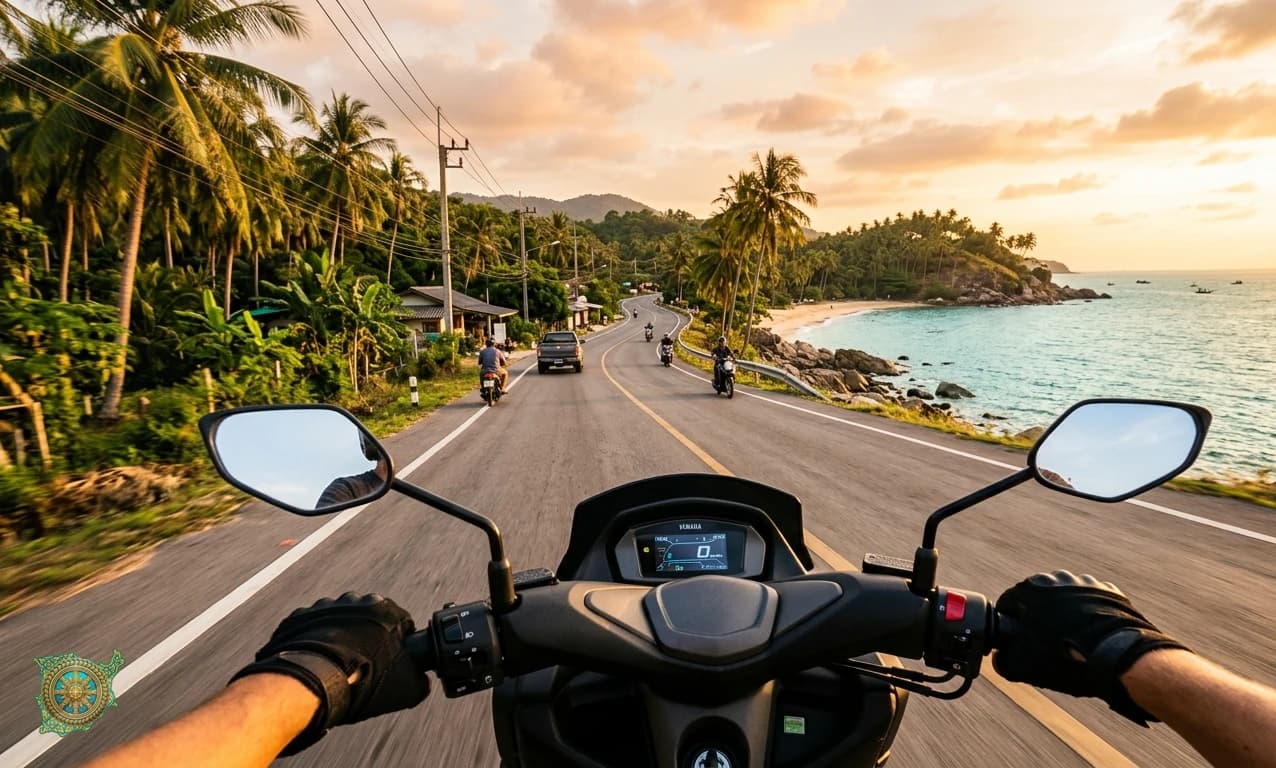
Above Chaweng Lake on the viewpoint access road last May, a squall dropped 20 millimetres of rain in 8 minutes. I was on the NMAX 155 descending when the road changed from dry to wet inside 30 seconds. I applied the front brake at 55 km/h on the first painted warning line. The ABS activated - the characteristic pulsing through the lever - and the bike stopped in a straight line. That was my first direct comparison between ABS and mechanical braking on a wet Samui descent and it was decisive.
Testing ABS at Samui's busiest junction types - the traffic light intersections near Chaweng Central and the uncontrolled T-junctions on the north coast road - produces consistent results. Hard front brake from 40 km/h on painted road markings: no wheel lock, controlled stop, bike stays on its intended line. The same test on non-ABS rental scooters produces a front tyre that chatters across the paint and a bike that pulls slightly to the camber side. That deviation is the moment where a junction becomes a fall. ABS eliminates it.
Last October on the gravel track descending from the rubber plantation above Ban Bangrak, I applied the NMAX's front brake hard on loose gravel at 25 km/h. The ABS activated and slowed the bike, but the front tyre still tracked into the looser section and the bike moved off-line by half a metre. ABS prevents wheel lock, not lateral slip on loose surfaces. On Samui's unpaved tracks - the Silver Beach approach, the dirt section near the southern tip - ABS is an assist, not a substitute for slow speed.
The NMAX 155 ABS system runs a single-channel front configuration - the rear has conventional drum braking. I compared stopping distances on wet tarmac at 50 km/h: NMAX ABS, 18 metres; comparable non-ABS 150cc, 22 metres. Those 4 metres at 50 km/h in Samui conditions - where a tuk-tuk can stop without signalling - represent the margin between a controlled stop and a collision. The measurement was taken on the Chaweng-to-Lamai road near the petrol station, where the surface is level and the road markings are standard.
Last February I watched a tourist ahead of me on a non-ABS scooter lock the front wheel at the pedestrian crossing outside Chaweng's Central Festival mall. A food delivery moto had stopped suddenly across two lanes. She locked the front, went down at low speed, and slid into the painted crossing mark and stopped. She was unhurt; the bike had minor bar-end damage. I was on the NMAX 155 and stopped in a shorter distance without any drama. The separation was not skill - it was the difference between systems.
Seven years of riding Samui's roads through every season has produced a clear conclusion about ABS: it does not make poor riding decisions safe, but it removes several consequences of good riding decisions made at slightly the wrong moment. The most common scenario is hard braking on painted road markings in light rain - a situation I encounter six or seven times a year on Samui even with careful riding. The NMAX 155's ABS resolves those moments cleanly. On this island's roads, that is a feature worth having.

Interested in renting Yamaha NMAX 155?
Check live availability and pricing for the Yamaha NMAX 155 on Koh Samui.
Show availableFirst-hand Yamaha NMAX 155 guides from our local team - where to ride it, when, and how to get the most from it on Koh Samui.

Browse the fleet, check availability, and contact us directly from your phone. Free on iOS and Android.
First-hand road and trail guides written by our local team - where to go, when to ride, and what to watch out for.